5 Million Years on Kauai

I’m sure this will come as no news to all you Kauaiophiles: it feels nearly impossible to enthusiastically plunge back into daily life – whatever & wherever & however satisfying it may be – after a few days on the Garden Isle.

Until two weeks ago, R & I had proudly served as members of an admittedly small group of stubborn iconoclasts who refused to join the rest of Western Hemisphere humanity in their reverence for Hawaii.  Despite the songs, the lyrics seemed unintelligible.  Plus we don’t especially like hot, we don’t like humid, we don’t like to be tourists, & we have a fantastic beach right around the corner, thank you very much.

Well, it’s always humbling to be proven wrong.  We’d felt kinda sucked into this vacation – our job was to deliver our grandson to our daughter, then join her for a few days @ a friend’s place on the Kauai east coast.  (To be frank, this is probably the only way we would’ve gotten motivated to get over there, or anywhere else, for a few vacation days.) We somewhat reluctantly accepted our mission…5 days with the family then 3 on our own…the family part sounded great, but 3 days as members of  the predominant local tourist demographic -yikes!

kauai hen 2Silly us.  Kauai really does live up to the songs, & not only because of ubiquitous & colorful chickens.  This 5 million year old lesson in volcanic erosion & sloowwwiiinnnnggggg down (gotta stick to 40 mph on the two lane island roads) was oh-so-needed, & in time, welcomed…irrespective of torrential rain, R’s bad cold, comings & goings, & omg do we really have to fly home today??  & it wasn’t hot (a comfortable 70-75 F the whole time), it wasn’t humid (if you don’t count the downpour dampness), it was terrific to have a conveniently located & comfortable home to sleep & create random refrigerator meals in (e.g., an especially yummy homegrown avocado, snow pea & cucumber salad), we loved the family time (of course), & why had we thought slipping & sliding down muddy trails to new beaches wouldn’t be wonderful?  The house even offered up a well-worn copy of The Autobiography of Charles Darwin 1809-1882 as a serendipitously fun read (along with Moloka’i by Alan Brennert, lent to me by my good friend Tom).  Two books in one week – that counts as a real vacation.

I love that Kauai is 5 million years old.  Our ancestor primates were just starting to walk on their two hind legs about 5-6 mya.  This juxtaposition of time – of being able to observe what 5 million years looks like on this dramatic island landscape – was very helpful to my ongoing process of trying to integrate scientific information with an all-too-human perception of life & time.  5 million years is new volcanoes becoming old ones, unimaginable & ongoing climate & sea level change, & a lot of teensy mutations to countless generations of hominins & all other living things.  5 million years from now Kauai will be gone, new Hawaiian islands will have spring up & gotten old, & as for humans…well, hard to know what we’ll be up to at that point, if we’re even still hanging around in this home solar system.

The last night of our visit, as we lay in utterly black & silent darkness beneath the shadow of Mount Wai’ale’ale, one of the neighborhood male members of Gallus gallus domesticus let loose with a serious crowing challenge.  Over the next few minutes his fellow cocks joined in, each echoing the other in a joyful chorus weaving around the hills, eventually winding back to our local guy for the last word.

It was the song of the island, & we were finally able to understand at least some of its lovely lyrics.
Posted in A Warming Planet, Just an Everyday Life, Our Primate Nature | Tagged , , , , , , | 10 Comments

Turning a Corner on Time

It’s Day 2 of the New Year.  2013 is already strengthening its foothold, but I still chirp “happy new year” at the beginning of each sentence.  You’ll hear me say this for at least another week…as long as I can get away with it, really.  I love the optimistic nature of this humanity-wide holiday.  (I know…frivolous optimism isn’t my strength, but with the help of a useful annual ritual, this human primate can get there almost as easily as the next monkey.)

Planning for New Year’s Eve can be kinda stressful though.  We don’t have a tradition we honor every year, as many do, & I really do enjoy celebrating this intentional turning-a-corner-of-time (almost as much as I dislike the immediately-previous holiday).  Two (relatively) recent memorable New Year’s Eves were in Japan & Switzerland, & also one with good friends at the local Harbor.  This year the two of us had a bonfire in the backyard with detritus gathered from recent home improvement projects – wet & random, a few shots of tiki torch oil helped the fire along…we even made it to midnight to hear the firecrackers & clanging pots.  It was great – thank you R…the grilled mackerel was delicioso.

The ritual of new year, of turning a corner, is nearly universal in the world these days. Some cultures still celebrate their own calendars’ new year too, but the new year of our common worldwide calendar (thank you Pope Gregory XIII) is a time for humans around the earth to put the past behind & affirm admirable intentions for our coming cycle around the sun.  We do this as humans together, without regard for religion or class or nationality or political party or sexual orientation…as humans, together. Wow.

Apparently most of these admirable intentions, a.k.a. new year’s resolutions, don’t have the desired longevity, but the one I really do make an effort to keep is offering kindness. In the Buddhist tradition it’s called loving-kindness, & tonglen practice helps.  I’m also working on the concept of reframing…as in reframing the past.  Wish me luck!

& speaking of the past, in 2012 President Obama was re-elected and the Santa Cruz branch rail line moved into public hands.  I don’t need to reframe these; along with a huge sigh of relief, I feel a great deal of satisfaction at my dedication to & role in these matters, in particular the latter.  So, good-bye to the past year: thank you for the good it brought us, & farewell to the hard times.

I wish you all the best, or at least more sharing, smiles & satisfaction, in 2013.  & go Obama! – our greatest president in modern times.

Posted in Just an Everyday Life, Our Primate Nature | Tagged , , , , , , , , | 12 Comments

Arranging Your Face

He looks down at them and arranges his face.  Erasmus says that you must do this each morning before you leave your house: ‘put on a mask, as it were.’ – from Wolf Hall by Hilary Mantel

I find this face arranging especially trying during the holidays…the parties, the extended family gatherings, the inevitable unplanned chat while out on the shopping circuit with that work associate you once saw daily.  Uh oh, what do I want my face to say right now? Am I even able make my face reflect whatever warm greetings I feel compelled (& sometimes really do want) to offer?  Or can I be honest with this one, be honest about just wanting it to be the new year already, February actually, done with the seemingly interminable “happy holidays”?

The face is our front door…it may be wide open, it may be closed, or it may be deliberately done up in the mask of the day. I used to make heroic efforts with masks & armor every time I stepped into my office, but I was never very good at it.  This could be considered a disability – in that arena, it was definitely one of mine.

Facial expressions are an essential, universal aspect of human primate bonding and communication.  Charles Darwin early on recognized this key element of human nature & wrote about it in The Expression of the Emotions in Man and Animals, published in 1872 as his 2nd volume (right after Descent of Man) specifically addressing human evolution.  If we allow it, our face reveals what’s going on in our amygdala – that deep, old, emotional part of our brain: our fear, anger, surprise, contempt, disgust, happiness, sadness, & my (apparent) favorite (just ask my family): skepticism, as demonstrated by slight but oh-so-communicative raising of one eyebrow.  Ergo, our attempts at closing that door to others stem from a desire to conceal our emotional states, probably in relation to demonstrating our degree of mental control over them, or because we sense others (understandably!) don’t really want to see what’s behind that door.  And while chimpanzees can to some extent control their facial expressions, only human primates seem to hold this deception as a daily objective.  I did, I do still, but it’s harder to justify these days because, to be honest, I don’t need less connection with my fellow humans right now, I rather need more…can’t see those facial expressions on FB or in text messages (although, granted, sometimes I’m relived to not be able to see them).

Which brings me to that other mask that some of us (usually female) wear, a.k.a. “putting on my face”.  Chalk another one up to being part of the feminist generation – I never did get into this.  Now, at 60-something, I suppose I could make a small effort to hide those distracting sun-blemishes, but at this point, why bother?  I do however make the daily effort to don eyebrows (!), & know from my mother (from whom I no doubt inherited these mostly invisible & scraggly things) that this does not become easier over the years. Some women dread bad-hair days, but I dread bad-eyebrow days – eyebrows being, after all, key to that (apparent) favored facial expression.  Someone suggested tattooing them on, but having survived the punctures of a very small tattoo on my ankle a few years ago, it’s impossible to imagine voluntarily subjecting myself to the surreal pain of two eyebrows. No thank you.  If you can’t read my face because I forgot to put on my eyebrows, you’ll just have to ask me…I promise to not shut the door on you.

Here’s to the light of the new year.  May it include more joyful facial expressions, & fewer of the others.

Posted in Cackling Crone, Just an Everyday Life, Our Primate Nature | Tagged , , , , , , , , , | 9 Comments

Norwegian Tortillas in Four (Short) Chapters

1  Family Heritage.   When your parents are from Minnesota (& you’re anywhere near my somewhat advanced age), there’s a high likelihood that your ancestors are either from Lefse from Scratch: Worth the Effort?Sweden, Norway, or Germany, with a few other random northern European bloodlines thrown into the genetic mix.  Who else would tolerate that northern Midwest climate??  The day after they married in 1948, my folks set out for California, where my father had been stationed in his Navy days during World War II.  He claims that honeymoon trip west is when he discovered my mother’s secret wish to be a race-car driver.  If you’d ever met my mother, you know how amusing this secret little wish of my father’s really was.

Anyhow, when I was growing up in SoCal post-WW2, acknowledging our German ancestry was verboten.  (Lucky for them, Minnesotans of German descent weren’t imprisoned like families of Japanese heritage were in the West.)  I learned my last name ‘Wilshusen’ by listening to my mother spell it out on the phone & in the shops, but my parents pronounced it without the “h”.  One of my many little acts of asserting independence from the family tradition was to pronounce my last name with the “h”, as in ‘will-shoe-zen’.  I’m happy we always shared the ‘zen’ syllable at the end, though.

2  Tradition.   Since the German (father’s side) was off-limits, we leaned toward the Swedish (mother’s) side of things when the winter holidays rolled around (although Christmas in LA mostly meant that we couldn’t jump into the pool anytime we wanted).  We spent all our holidays (& many summer camping vacations) with my mother’s older sister Aunt Peggy & family, & we fervently loved her as the lady who fed us special Scandinavian treats: sunbakels, rosettes, & our family favorite: Lefse, a.k.a. (on Live Oak Avenue at least) potato tortillas.

lefse 1212

Live Oak Ave. lefse kitchen scene, paddle front & center

3  Making Lefse in Santa Cruz – The Ultimate Comfort Food.   I happily became the carrier of the family lefse tradition.  I remember being so protective of this special mantle that I was jealous of my future brother-in-law Mark’s beginner’s luck at rolling perfect circles, making my (still) free-form shapes seem amateur & pathetic.  (I now know that Mark can out-cook me anytime, anywhere, so I’ve let go of trying to compete with him on anything related to food.)  Nevertheless, I’ve persevered (…perseverance being, for better or worse, my other middle name…) with this important family role.  & even though I cling to a make-do approach (& not only for lefse production…), I’ve finally progressed to realizing the benefits of using an official lefse ‘paddle’, which I procured in a small Benson, Minnesota shop during the (mother’s side) 100-year Young family reunion a few years ago.

I need to consciously prepare & energize myself for this project of love, because aside from the comfort food aspect, it’s a flour-y, messy endeavor, & not only because I mostly make it as a gift for far-away siblings.  Here’s the basic recipe: use leftover mashed potatoes, flour, butter, & salt; mix 2:1 potatoes & flour, add some soft butter, add salt, knead a little, refrigerate, roll out & pan grill.  Slather the tortilla with butter (see below), cinnamon,  sugar, cheese, or anything equally sinful, roll up & savor with small bites.  I only suffered minor cooking injuries last night: a few burns from the electric pancake grill & sore arms from rolling roughly the equivalent of 40 pie crusts.

lefse julie

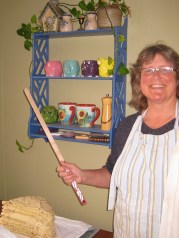
Julie with paddle & perfect lefse

Last New Year’s Eve day I enjoyed a two-day lefse lesson with my friend Julie & local Lefse Queen & Connoisseur Robin Woodman.  I learned to appreciate the full-blown, official way to make these delicate potato tortillas, but my own method will probably remain a basic, down home approach.  As with so many things, there’s a whole lefse culture out there with elaborate recipes, procedures, special cookware & rolling accouterments, etc. (- leftover potatoes are a big no-no in these versions).  No doubt the results are slightly better than mine, but really, it’s the love & the connection that makes it yummy (uh, & maybe also the the ingredients?…).  & although, sadly (happily?), few of my friends seem appreciate this winterland-without-sun delicacy, it’s gratifying that daughter Z expresses robust Minnesota lefse genes – I can only hope she’s also passed them onto sweet grandson Dante.

4  In The Meantime, Please Pass The Butter.  I have an alternate definition of L.E.F.S.E.: Lovely Excuse For Satisfying Emollients.  It’s the pleasure & the pain of enjoying these sorts of things…truly shocking how quickly potatoes, flour & butter metabolize into belly flab.  Ah well, it must have served some evolutionary purpose during those long cold Scandinavian winters.  & I can easily imagine how it was a lovely way to pass a few dark hours until the Winter Solstice heralded the coming light again.

Posted in Humans Love Food!, Just an Everyday Life | Tagged , , , , , , , , , , | 11 Comments

Longer Than You Think

Have you noticed that whatever the project, it takes longer than you think?  Uh, like, much longer.  Never, ever shorter.  Definitely not your usual bell curve of averages.

Especially at this time of year, it seems.  I (thankfully) didn’t host or even organize the thanksgiving food orgy this year (yay daughter!) – & even though this is my favorite holiday, it does take a certain measure of self-control to not face the next morning with regret, gi, social, or otherwise.  I know from past experience that the thanksgiving to-do list can be long on tasks & also long on optimism, usually due to all those lovely heartful feelings of Fall, & knowing that we can work it out.  But of course, one never accounts for the inevitable TG dinner snafus (present & past)…the cut finger (wouldda never injured myself w my pathetic Cutco knives…), the oven that won’t turn on (omg, you’ve never used it before?!), gravy disasters (hey, we can substitute grandma Ann’s fabulous cranberry sauce & yeah, butter too, OK?)…not to mention that even cutting onions & bringing the lovely bird over from the good friend’s functioning oven takes longer than you think.  Yeah, geez…everything takes way longer than you think.

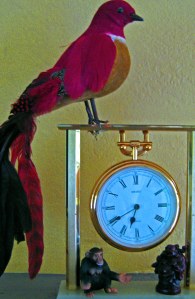
We humans have codified Time into months (roughly one cycle of the moon around the earth), years (one cycle of the earth around the sun), days (one rotation of the earth itself), 7 days in a week (…interesting speculation about where this came from, the most plausible to me being the 7 visible celestial bodies), 60 minutes in an hour, 24 hours in a day, etc. But, none of this measurement means that we perceive time according to the math.

We all know it: irrespective of the clock, time is relative for the human primate…relative to our feelings of the moment, our memories of the past, our anxieties &/or hopes about the future.  I vividly remember the moment I observed our grandson Dante understanding (at about age 2) that even though he was leaving grandma & grandpa’s home right now, he would be back in a few days…for him, this realization was a life-changing, integrating (& calming) feat of new neural connections, & a foundation for the human conceptualization of the future (as well as the past & ever-elusive present).

He (thankfully) doesn’t feel it yet, but we do…there never seems to be enough time.  To cook the thanksgiving dinner, to get to the meeting, to work at staying centered, to be alive.  I have a strategy that I call shedding which works pretty well when I manage to perceive that my concept of time is not equivalent to the persistent ticking of the clock:  I delete.  Cancel a date.  Don’t cook dinner.  Get a refund on the trip.  Can’t make it to the meeting…so sorry, you know how it is.  It’s my way of managing this way we are, the way I am.  To have more time to breathe.

& sometimes (thankfully), it even feels that I’ve momentarily worked this time thing out.

Posted in Humans Love Food!, Just an Everyday Life, Our Primate Nature | Tagged , , , , , , | 1 Comment

Maybe It Was The Sashimi…

…as in fish, not fauna, that nudged our ancestors of 2 million years ago (already striding on their highly-functional feet) along the path toward larger & more complex brains. Granted, they probably didn’t enjoy succulent hamachi like we do today (no doubt a pleasure our descendants will marvel at…), but there’s ample evidence that the omega-3 fatty acids in fish are really good for us, & I’m guessing they were also good for the growing brains of our long-ago grand-ancestors.

As much as I love meat, it seems to me that fish & other aquatic creatures are being unfairly submerged in the quest to understand why & how our ancestor hominids were able to survive with more & more energy-sucking brain cells.  A recent study asserts that cooking meat provided homo erectus folks of 1.8 million years ago with easy protein – & well, our love of barbecue definitely makes this seem plausible.  The only problem is that thus far, there’s no accepted scientific evidence of routine use of fire for cooking until about a million years later.

It seems clear though that something changed in our ancestors’ daily lives from around this time.  Significant modifications in teeth (smaller teeth, jaws, & canine teeth), shorter digestive tracts, birthing of increasingly more immature infants, & reduced difference in size between females & males (sexual dimorphism) all indicate that a key factor was probably both what they were eating & how they were obtaining it.

Raw animal meat is difficult for primates to digest, ergo the idea that some form of cooking was necessarily involved.  If we broaden the notion of cooking to include soaking, fermenting, drying, pounding, etc., it becomes plausible that our omnivore ancestors were getting brain food from not only the occasional large animal, but more likely from anything they could literally get their hands on…& creatures sitting or slithering in the water certainly weren’t beyond their reach.

The problem with arguing that aquatic food sources were fundamental to early human primate diets is an unfortunate lack of evidence.  While telltale cut marks on fossilized scavenged (or even hunted) bones is legitimately interpreted as evidence of early carnivorous tendencies of homo erectus, eating juicy amphibians or sucking small tasty sea creatures out of a shell & tossing away the empties doesn’t leave much for paleoanthropologists to discover & write home about, especially if this fragile evidence is now underwater due to climate & associated sea level changes over the past 2 million years.

There is something, though, that ought to give encouragement to fish-lovers: the first human necklace was made of shells.  More on that later.

MUSSEL SHELL was engraved by Homo erectus between 540,000 and 430,000 years ago. Image: Wim Lustenhouwer, VU University Amsterdam

updated 12/5/14.

Posted in Humans Love Food!, Our Primate Nature | Tagged , , , , | 11 Comments

Spinning in the Wind

By now the images are familiar: satellite shots of monster hurricane Sandy bearing down on the northeastern U.S. seaboard & scenes of cars floating like ice cubes in dirty floodwaters.  We all do what we can when the wind comes…move stuff out of the way if we have time, & stock up on random stuff we wouldn’t even glance at otherwise; anticipate our future thirst, though what we have to quench it never seems like enough; & try to hold our ground, if we have nowhere else to go.

The winds of earth are powerful, uncontrollable, & now, more unpredictable.  The people of the Caribbean & Florida (including two siblings) are apparently accustomed to being buffeted by frightening hurricane winds, but not folks in New York (or in most parts of our country), not at this time of year, & not at this magnitude.  Scientists are coming to understand that the northern hemisphere jet stream is changing in response to climate change, specifically the unanticipated rapid melting of Arctic ice.  And this means yes, these unexpected & damaging weather patterns are probably the new normal, at least for a while until they shift again in concert with other climate change factors.

Daughter Z has a tattoo which says “le vent nous portera“…the wind will carry us.  A few years ago I made a sculpture with these words; it’s out there in the garden as reminder of the winds of change, the ones we feel on our face & the ones we feel in our gut.

Having lived through a major earthquake here on the west coast, my heart goes out to everyone who will spend months & years & even decades cleaning up & rebuilding after this recent traumatic event.  I’m afraid though that there’s more to come…much more.

But before I completely cast our primate fate to the wind, consider this: we seriously need to take a Tai Chi approach with this wind stuff.  Beyond sailing & kites, we can work together with the wind, & we can make it work for us.  There’s no question that wind is an abundant & ‘renewable’ energy resource; other nations & communities are catching the drift.  Small local steps in this direction are hopeful, but we need to do…much more!

The wind can destroy us…&, the wind can also carry us.

Posted in A Warming Planet, Just an Everyday Life | Tagged , , , , , , , | 3 Comments

Two Feet on the Ground

I just finished Nora Ephron‘s book, I Feel Bad About My Neck, a.k.a. “I Hate My Neck”. Omg, I hate my neck too: “You have to cut open a redwood tree to see how old it is, but you wouldn’t have to if it had a neck.” (p.5)  I actually used to feel kinda of proud of my long neck, but be forewarned – a long neck is a definite disadvantage as one puts on the years. Can’t say I’m exactly fond of my other, gravity-responsive body parts either.

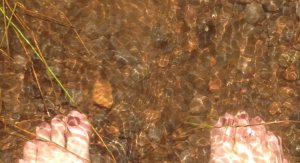
But, I love my feet.  Pedicures & foot massages, aahh… & have you noticed that feet seem to be the body’s main temperature control organ? Feet don’t sag (or at least we’re too far above them to observe that very often); they don’t seem to have fat cells that (unlike the belly) become noticeable anytime we eat a sinfully delicious food (i.e., bucheron cheese); we don’t have to look at them too often in the mirror unless we’re trying on new boots; &, they’re in the perfect location for fun (& functional) accessorizing.

Feet: our special human primate bipedal-walking paws.

One of the big mysteries of human evolution is what aspects of natural selection were at work when our ancestors started moving around upright more often on two hind limbs, first, in the trees & then, on the ground (& maybe in boggy estuaries, too).  Numerous narratives speculate about why some arboreal apes ventured down from the trees 6-8 million years ago.  A common thread in these theories is that our hungry primate ancestors responded to a changing environment by [literally] walking into an unexploited environmental niche, allowing them to obtain food both in the shrinking tropical rain forests as well as along the expanding grasslands on the edges of the forests.

Bipedal walking was the “prime trigger of human evolution” [Stephen Jay Gould]: it freed up our forelimbs & paws to carry things & eventually to manipulate tools, & made precious energy available for other uses – most notably, our eventually-expanding brains.  Walking also forced our early ancestors to figure out, with the help of family & friends, how to birth & survive with their smaller, helpless, ‘underdeveloped’ infants (still a common problem due to mama’s narrower hips & baby’s larger head).

By about 2 million years ago, our fully bipedal ancestors walked on highly-functional & much-modified feet, connected with their longer legs (via also-modified but, it seems to me, not-quite-so-functional ankles & knees), realigned hips, & a curved spine, which now held their head comfortably in an upright position (…all the better to talk with, somewhere down the line).  The big toe (hallux), which functions & looks like a grasping thumb in our closest chimp & bonobo cousins, retains a starring role in human feet as the key mechanism of propulsion for our energy-efficient mode of locomotion.  It’s what eventually allowed for evolution of the 7 billion of us alive today.

But hey, back to me!  I’m thankful when my beloved feet are working properly, & agonize when they’re not.  I love that there are ancient medical disciplines entirely focused on the foot (& hand).  I wonder at the period in Chinese history when, in order to distinguish between social classes, Chinese culture uniquely went in the direction of binding female feet such that walking was nearly impossible.  Personally, I take great strides (accompanied by many hours of putting my feet up) toward trying to maintain my balance & stay grounded.

& happily, in this moment, I’ve got new boots on & they’re (you guessed it -) made for walking.


_______
revised 4/19/15.

Posted in Cackling Crone, Our Primate Nature | Tagged , , , , , , , , , , , , | 5 Comments

Savoring Sunlight

It seems that the taste of fall sensed early in August is already setting the table for Thanksgiving – the equinox this year was a spot on marker of our earth’s annual cycle around the Home Star.  Fall has already dropped heavily upon us…golden leaves dripping into fading gardens, heavier blankets needed on nighttime beds, although this week: back into October’s little summer.

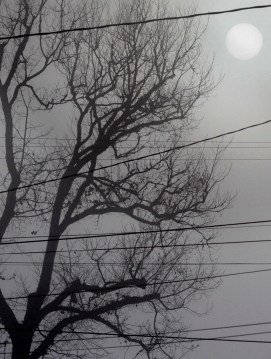
Unlike last summer’s unrelenting fog, this one was full of unrelenting sunlight.  I’m not complaining!  Some days, though, it felt almost oppressive – uh oh, another glorious day on the central coast that requires a happy face & joyful time spent outside.  I’m thankful… really.  But there’s one very special effect of fog that I always appreciate when it lingers for a few moments: being able to look directly at that sphere of a star, our own Opulent Orb: its overwhelming size (we’re so far away!) & its role, along with water, at the center of Life.

I think that when you’re lucky enough to see the sun through fog (a state of water? a state of mind?), you really have to pause & fix in your mind the location of your feet on this planet, & our collective circling around this fair star. Then, if you have the time, you can move your mind outward to this star’s age (about 4.5 billion years old)  & its location in our home galaxy, & how many galaxies are out there that we can’t even conceive of, & on & on….if you have the time.  When I have the time, looking at this muted orb stimulates involuntary deep breathing…for a few moments anyway – this visceral sun-fog viewing being always too fleeting.

Today is my 63rd birthday – egad, as my father would say.  Please, I’d really love & appreciate your warm wishes for this upcoming year – just whisper them to me in your mind (because sorry I’m not into tedious happy birthday posts on FB & elsewhere).  I’ve decided that my tarot card for this year is The Sun (because although we don’t take this too seriously – do we? – it’s helpful to have a mantra occasionally).  I know, The Sun card is pretty mundane, but here‘s why: the sun will always bring another day (even, & especially, if it’s shrouded in fog).

Call it “fogs of confusion” if you like.  I’m sticking with the (not very original) notion that it’s foggy days that allow us to really savor the sun.

Posted in A Warming Planet, Just an Everyday Life | Tagged , , , , , , , , | 6 Comments

When Sluggish Is Good

Slugs have a bad rap…uh, sorta deservedly.  Have you ever gotten up in the middle of the night, sleepily wandering to the kitchen to look at the waning moon or pour yourself a glass of water, when aacck!~ you step on that slimy creature near the back door… then it’s an hour of reading to calm down after spending 15 minutes trying to get the slime off your foot.  Yuck.

But let’s move to metaphorically speaking. I’m going to avoid my usual rap about how slugs are creatures like all the rest of us, trying to survive & reproduce (did you know they’re hermaphrodites?), etc etc.  Slugs have a special role in our stories.  The Economy. The Recovery. Humid weather.  Moods.  Because sometimes we just feel like them.  Sluggish.  Moving ssslloooowllyy.  Aimlessly, it seems.

Like today.  Aarghh, I even put chores on my calendar for this afternoon so I’d do them.  For better or worse, I’m so calendar-driven that I actually managed to spray a little water on the slug-chewed plants (after 5 pm of course), & clean chicken poop stains off the deck (my absolute least favorite chore), but really, I was dragging, slugging along, wishing I could just lay down & take another nap (aka ‘recumbent meditation’).  I guess some days it just works better to move slowly (- & yes, I have the luxury of doing that, even though it doesn’t sync with my usual self image).

It seems to me that one (very big) arena where we should be wishing for the slowness of sluggish is climate change.  Like many of you, I’m on a few news lists & happened to read a blog on the Forbes website the other day challenging the climate change ‘alarmists’. Looking into this a little more, it seems that serious deniers of climate change are alive & well within the ranks of this major business magazine.  Well, technically they’re not deniers of climate change per se, but rather deniers of the now undeniable evidence of rapid climate change.  Rapid = not sluggish.  Rapid = not much time to adjust.

There’s no denying it – there are those who like rapid.  Rapid Growth.  Rapid Turnaround. Rapid Permitting.  The thrill of running rapids.  Most scientists agree that there were and are conditions that can cause the pace of evolution to be rapid, but please note: generally-speaking, they’re not talking about easy adaptation to the radical pace of change – over just a few decades – that we’re experiencing with earth’s climate.

The very serious problem we’re facing is what, if anything, we will do about it.  Human primates that we are, it’s difficult for most of us to believe that our own action (as one of     7 billion) makes any difference one way or another…& it’s hard to argue that it does.  & while I generally believe in incremental (sluggish) change, I really wonder how humans will be able to affect the accelerating nature of rapid climate change without some kind of radical shift in our perception of the problem.  At this point, I think that shift will itself be climate-driven, ie., climate-crisis driven, & although it probably won’t change what happens with the climate, it could change how we respond to it.

So I wonder now, more often, about how to be better prepared for the seemingly inevitable climate crises-to-come.  Unfortunately, this kind of thinking can easily lead to ‘future scary mind’ overruling stay-in-the-moment mind; when that happens, the primate-slug bond can be powerful.

Thank heaven I can fall back on recumbent meditation when sluggishness overwhelms.

______________________

p.s. I swear this post has nothing at all to do with a banana slug being the beloved mascot of my college alma mater.

Posted in A Warming Planet, Just an Everyday Life, Our Primate Nature | Tagged , , , , , , , | 5 Comments