Grinning @ The Driver Next Door

Still on the silliness kick I guess, but hey, why not?  Plus there’s evidence that smiling more makes you feel like smiling more…who woulda thunk?

I’ve noticed that something changes when we get inside that little wheeled mobile unit – we just want to keep on moving.  We don’t want anything to slow us down or get in our way.  Our expectation for continual motion drives us away from our more pleasant natures.  By now, we all know about road rage, but as things get rougher out there, do we know enough about how to avoid it?

Because – & I know you’ve never heard me say this – we can fantasize that making more lanes on downtown streets or local highways will solve our problem, but there is ample evidence that it won’t.  We all (& I’m including myself here) really do need to seriously adjust to the reality that moving around in cars isn’t ever going to be cheaper or easier or faster or good for the environment.  Parking all those cars we’re driving isn’t ever going to be cheaper or easier or faster, etc., either.

Well, OK, I know enough of this life to never say never…we don’t really know what’s around the corner for any of us, except we do know that rapid climate change will affect (is already affecting) all life on earth, no doubt in mostly unpleasant ways for humans.  Unless there’s a tragic drop in human population, or advances in alchemy, the future we’re now careening toward will no doubt mean more walking, biking, & transit for all of us, not more car driving.  Irrespective of how many Chinese billionaires are buying black Mercedes.  & irrespective of short-term thinking about high speed rail in California.

But, to get back to our emotional state while we’re still (usually alone) in that car, still in that traffic.  I try to practice a great suggestion from my meditation teacher to turn off NPR & instead, to cultivate compassion while driving.  We know that we’re all pretty much in the same, uh, boat out there – trying to cover too much ground in too little time, with unadjusted expectations about travel time reality; distracted by random anxieties; obsessing about events that happened in the past or could happen in the future; & (here’s where the grinning comes in) annoyance (or even real anger) at what that other guy is doing (or not doing) to make our too-long journey less safe…& yes, she also recommends practicing deep breathing.

Will these tactics get rid of traffic congestion?  You know the answer to that.  Will it get rid of the idiot flagrantly gabbing on his cell phone while attempting multiple lane changes? Sadly, probably not.  But it could make our busy lives more livable.  & it could offer a sweet connection with that nearby human, despite the metal box we’re both encased in.

So, I promise to pay attention in that auto.  I promise to practice grinning with generosity. & I promise to let you cut in front of me if you put down that cell phone & smile back.

Posted in A Warming Planet, Just an Everyday Life | Tagged , , , , , , , | 3 Comments

Frasier @ Bedtime

WARNING!   The contents of this post contain absolutely no science, pop-science, or bonobo references.

Hey baby I hear the blues a-callin’, tossed salads & scrambled eggs…

Just signed up for cable TV a couple of years ago.  We didn’t own a television when the girls were growing up…yeah, they were envious of their friends watching Bert & Ernie. Eventually we found an old cast-off black&white with a few free channels, but by then the girls were reading (avidly) & drawing (avidly) & not too interested.  Over time we advanced to color TV, but when everything went digital – no ‘free’ channels anymore – we just let it go.  The daily exercise regimen required after hip surgery however was an incentive to join modern day America…Basic+, + we could get a sense of why things are going strangely in modern day America (as if reading the newspapers – yep, I’m one of those – isn’t indication enough).

I’m making some progress in becoming a reformed Cable Luddite.  My friends Chris & Pat do their best trying to drag me into the 21st Cable TV Century, but really, I’m thrilled when I can manage to get back to Rachel Maddow, the Science channel, or Frasier after someone has accidently pressed the ‘wrong’ keys on the cable or TV remotes.  They know me at the call center:  I’ve figured out that if I press ‘1’ to agree to a post-call survey, my distress call is answered right away.  I always tell them they’re doing an excellent job afterward…& really, they do help me figure it out.  I only get annoyed when they start out with “Ma’am, is the TV is plugged in?”

So, FRASIER!  so much better than ambien at bedtime.  I can feel virtuous by exercising & I can tune in or out – the storylines are secondary to the situations.  How on earth did I miss these characters the first time around in the 1990’s?  I’m sure they would have made my then very-stressful-work-&-mother-of-teenage-daughters life more bearable.  Maybe goofy & pompous-but-lovable psychiatrists didn’t seem as funny then.  Well nevermind, the gang’s around again – two full hours nearly every night!  I know, they’re on Netflix, etc, too, but I’m sooo on-top of the remote these days.

Because where else in modern day life can we internally nod & sigh at “It is in darkness that our minds give shape to our deepest anxieties“, or “How loosely woven is the fabric of our happiness” while we’re laughing (ol)?  I love these guys.  I’m continually amazed at the human lusts-&-foibles script, and the consistently terrific comic counter-point about our everyday lives.  To Eddie, Niles, Frasier, Dad, Daphne & Roz…thank you.

This is Dr. Frasier Crane, wishing you good mental health.”  I wish that for you too.

Posted in Just an Everyday Life | Tagged , , , , | 11 Comments

Next Movie: Disney-fied Bonobos?

A few weeks ago, I talked my 8 year-old niece into seeing “Chimpanzee“, again.  She’d already seen it & even though the reviews were so-so, I felt it was my duty as the everyday primate to see Disney’s take on one of our closest cousins, Pan troglodytes.

Nikko, you were really a trouper to see this movie again!  Thank you, sweetie.  I can totally understand that you fell asleep about 2/3 of the way through.  I stayed awake though, furiously writing notes about the too-human us vs. them story line which obliterated any enjoyment of seeing real chimps in their real African environment.

Because, sadly – in spite of Oscar, the cute baby chimp whose mother dies in the movie but who (apparently really, but unlikely in fact) ends up being taken under the wing by the ‘good guy’ alpha male – sadly, the reviewers were right.

Here’s my comment on the NY Times film review:  “This movie was anthropomorphizing at its worst. The good guys (including mommies & orphans) win due to “teamwork” & the bad guys (“thugs”) lose because they’re into “brute force”?Chimpanzees are interesting enough without the “rival mob” narrative: here are some more words used [in the movie] to characterize the ‘other’ group & its interactions with ‘our’ group: gang, invasion, attack, pillage, enemy, & army.  Are we gearing up for another war?  What a disappointment.”

It could’ve been a great film.  The real chimpanzees, the real drama of their lives (yes they do fight with & occasionally kill each other), the lovely shots of where they live… jeez Disney – you could’ve done a real service to our understanding of these close relatives of ours.  I know you were trying – even showing our real animal cousins on the big screen is progress.  But please, for next time, for the bonobo movie you’ve got to be planning (right?! – the one about our other cousins??), please feel free to call me during the test screening phase for an honest opinion.

I love to imagine the plot of “Bonobo” (uh oh – would it still be “G” rated??) …young Oscar is with his mommy, who happens to be the alpha female (and therefore leader) of the group; he’s enjoying playing with his cousins & older brothers, who will stay in the group & retain their status via their mother (who won’t be killed off in the movie by the ‘bad guys’ because there really aren’t any in bonobo society).  When little Oscar greets his playmates, they engage in a little quick sex for a few seconds, then scamper up to swing around in the soft, light-filled trees.  When a neighboring group ventures into their territory, drawn by the tempting, ripe fruit, they all have a little more sex for a few moments before sharing the bountiful harvest.  Sure, there are a few minutes of tension & bipedal, scary posturing, but before long, everyone settles down & enjoys the feast, & the nap of sweet satiation afterward.

No doubt it would be called a chick flick.  Works for me.

Posted in Our Primate Nature | Tagged , , , , , | 4 Comments

Yay For Pop-Science!

I almost included “Good” in the title – as in Good Pop(ular) Science.  But of course, good goes without saying.  Just as we like good science, we should also demand good science communicated in ways that the general public can understand & appreciate.

Wanna speculate about why a recent poll shows that over the past 30 years, there’s been no appreciable change in how the U.S. public views human evolution?  The good news is that the percentage of those polled who understand that humans evolved without any intervention from God increased from 9% to 15%!  Hey, if I were a journalist, my headline about this poll would have read: “Nearly 70% Increase in the U.S. Public’s Understanding of Human Evolution”.

But that’s not how the headlines went.  Because the not-so-good news is that most Americans polled (78%) still think that either God created humans as we are today (46%), or that God guided evolution (32%).  I can try to blame these jaw-dropping numbers on poll methodology (not enough cell phone numbers vs. land lines?) but even so, can’t help a Big Sigh.  The public’s grasp of fundamental science still has a long way to go when it comes to accepting the basics of how we got here.  It probably didn’t help that in 2006, the Bush Administration tried to outlaw evolutionary biology as an acceptable field of study.

But, back to my question:  Why are we – the American public – still in the dark ages when it comes to the science of evolution?  Of course, the answer is complicated.  Life is complicated.  While it’s easy to blame the producers of Fox News (& I do), it also, imho, has to do with scientists being so focused on being scientists that they’re neglecting their role as communicators.  Poll numbers like these (even if they’re off by +/-4%) should be a sobering reality check for those of use who like to say ‘show me the data’.  Scientists and their compadres, science journalists, need to become better communicators about the Amazing Story of the Evolution of Life As We Know It.

I know, there are those who disparage storytelling when it comes to science.  I’ve even heard talk of the “fetishization of brain science”, as if some of what we’re learning from neuroscience (e.g., that humans love stories) is too coarse for the dignity of intellectual and scientific discourse.  I disagree. We need to keep trying to figure out better & more engaging ways to communicate what scientists are learning about how our brains & bodies & environments work, and about how they work together: via stories that can help us understand why human primates (and other fellow creatures) do as we do, & think as we think, & feel as we feel; and by transmitting these stories via the various communication modes that humans are now using (even if we may disparage some of those modes).

I have huge admiration & respect for the day-in & day-out exacting & meticulous work of scientists.  I really appreciate that they do what they do well so that people like me can accept their conclusions as my world-view.  I even (sometimes) enjoy their debates about the (sometimes) obscure-but-no-doubt-key details.  But apparently the big picture is not getting through to folks on the street, nor to kids on the tweet.

C’mon y’all, let’s do a better job at learning & sharing the Amazing Story!

Posted in Just an Everyday Life, Our Primate Nature | Tagged , , , , , , | 2 Comments

Revenge of the Oak Moth

They’re trying to compete with the human takeover of Earth. They camouflage themselves with fluttery, seductive, feathery-sweet wing-light in the late afternoon, but we know better.

The California Oakworm or California Oak Moth (Phryganidia californica) is in its first mating season in Santa Cruz County (hold on folks, there can be two or three mating seasons each year!).  Last week, while walking in Schwan Lake Park & along the rail line, I could hear the clamourous masticating of caterpillars & the dropping frass of their letting go.  Then it was errily quiet for two days.  I knew what was coming.

The Oak Moths.  Scientists say that there is an 8-10 year cycle of the closely-linked Oak Moth and tasty leaves of our gorgeous California Live Oak trees (Quercus agrifolia). But it hasn’t been eight years since the last infestation.  This is happening nearly every year.  Is it because of climate change?  Not enough predators?  What’s going on??

I’m all for relational evolution (hmmm, is this a scientific term?).  But as the dominant Earthly species, can’t we have a say in this?  Caterpillars that love to attach themselves to our clothes & hair are kinda creepy, don’tcha think?

Of course, it’s not their fault.  They’re just being Oak Moths.  They don’t know or care that they’re being annoying & defoliating our beloved oak trees.  They’re just trying to mate & carry on the species.  Just like us.

Well, except we human primates have something we call awareness about it all…about being annoyed by caterpillars & worried about tree damage & yes too, buoyed (momentarily) by the magic of multitudinous flying beings flitting around everywhere.  It’s our blessing & our curse, don’tcha think?

Ah, for the simple life of metamorphosis.

Posted in A Warming Planet, Just an Everyday Life | Tagged , , , , , , , , | 8 Comments

What Would Samwise Do?

So I’ve been doing alot of musing these days about loyalty, struggling with it, really.  The loyalty stuff on my mind isn’t at all equivalent to the drama of trueheart Sam’s famous loyalty to Frodo & the Quest-To-Deliver-Middle-Earth-From-Evil…no, nothing like that. Just your everyday loyalty (& sometimes conflicting loyalties) to family members, worthy causes, old friends, new friends, women friends, breakfast buddies, grocery stores, President Obama, random groups that I’ve participated in or contributed to forever, my hens, Friends of the Rail & Trail…you know, that sort of loyalty.

…not to mention dog loyalty, cat loyalty, basketball, red & blue states, NIMBYism, patriotism, religion, Burning Man, Big Macs, Braveheart, the Crusades, the Cubs, the Euro, Tibet, Israel, iAnything, GPS – all big players in the loyalty arena.

I’ve been particularly loyal to several groups of women over the years.  Some of these include women I’ve known for decades – close friends from those early, heady Women’s Health Collective days in the 1970’s, to my down-home, tapioca-loving, card-playing quartet.  But others are mostly made up of women I barely know – for example, the ever-morphing Ten Sharps, women who gather once/year to support a Kuumbwa jazz show by a young(er than us) female artist.

So what drives me to hang in there with these gals, these groups, year after year?  & (more importantly for yours truly), for them to hang in there with me?  Why do I feel particularly uneasy when there is dissension in the ranks?  or when I perceive that my community is threatened by the evil other?

A summary of current research about human ‘in-group’ loyalty notes that “much of the early work in this area observed that humans are naturally predisposed to see the world in terms of social groups, spontaneously segregating themselves into groups based on the most minimal of grouping dimensions.”  Many primates share this preference for their in-group, although research in this area is not as robust as one would think, given how key this is to primate life.  It’s a hot topic among evolutionary biologists these days, however, with the latest offering of The Social Conquest of Earth, by Pulitzer-Prize author and naturalist E.O. Wilson, generating numerous critiques and counter-critiques among his own scientific in-group.  Clearly we’re not all yet agreed on how or when this aspect of human nature came about.

Generally speaking, our sense of well-being is enhanced by feeling that we’re part of a group.  This is what the scientists are studying: why is our in-group identity, & it’s out-group corollary, so key to human nature?  Did this aspect of our nature convey some kind of evolutionary advantage to our species?  What’s the response of our brains &/or hormones that kicks in when we’re really feeling good about our in-group, or fearful of the out-group?  What happens when this tendency goes awry?  One aspect that’s especially interesting to me at the moment is when & why loyalty can sometimes just be a habit, even an unhealthy habit (e.g., Big Macs – not that my unhealthy consumption loyalty is necessarily to Big Macs, but you know what I mean, right?).

Many took Samwise for a loyal-but-slightly-dull-Frodo-follower, only later recognizing that all of beloved Middle Earth would have been destroyed in the Ashes of Evil but for the strength of Sam Gamgee’s loyalty to Friendship & the Unquestionably Worthy Cause.  This is the grand vision of loyalty – when there’s no question about the rightness of the in-group & the wrongness of the out-group.  For the rest of us, though, I like this one:

“To be loyal and not bound.”

Posted in Just an Everyday Life, Our Primate Nature | Tagged , , , , , , , , , | 8 Comments

Cheese and Chicken Bark

I was standing in line at my favorite go-to market the other day & the fellow in front of me incredulously asked if I was “really going to eat” that (lovely) bucheron cheese I’d just placed on the checkout counter. Slightly (but really, not too) embarrassed, I responded that I can’t control myself when it comes to cheese, high fat content & all. Truthfully, I can’t recall ever having met a cheese that I didn’t immediately befriend. Turns out he wasn’t concerned at all about the fat; he was repelled by its goat nature.

That same day during lunchtime, grandson Dante, happily gobbling his tofu, kiwi, tortilla chips, & chicken breast chunks, turns to me & sweetly asks, “May I please have some chicken bark, grandma?” After I manage to stop laughing (& texting his mom about it, & realizing that I much prefer this term to ‘skin’), we talk about bark & skin & how really, they serve the same purpose of protecting other parts of the living being, & no, I didn’t have any chicken bark for him today (not entirely true, I’d eaten some myself when he wasn’t looking) but we agreed that it’s an especially yummy aspect of eating chicken.

Human primates (well most of us anyway) love animal fat (…memories of delectable pork fat dishes at The Pig’s Inn, Bishan, China…also see “What is it about meat?”). Easy access to animal food and carbohydrates were key aspects of our transition from a nomadic gatherer-hunter life to our (generally-speaking) current human lifestyle of living in established communities. This transition happened only 10,000 years ago, when our ancestors in the Middle East started domesticating wild grains and herding animals such as goats, sheep, & cattle, & eventually pigs and chickens (originally domesticated in Asia; there’s now evidence that domestication of cattle happened independently in Africa as well). The rest is history (as they say).

The jury seems to be out about whether animal fat is good or bad for us. Settling down changed so much about our human lives – how we eat, how we work, how much we move around, how we organize ourselves into communities & city-states, nations, etc.; &, it’s what kick-started the human population explosion that’s still accelerating today. There’s also no doubt that living together with animals affected our evolution into the human primate of 2012 – food-wise, body-fat-wise, & with respect to all those little virus & bacterial creatures with whom we share our bodies.

As is already obvious, I appreciate the contribution that our fellow animals & birds (& fish) make to our human mealtime. I thank goats & pigs & chickens & cows & sheep & fish for the gifts of food we humans appropriate from them. Yes, I agree, all in moderation. (&, I really do love kale.)

Posted in Humans Love Food!, Our Primate Nature | Tagged , , , , , , , , , , | 8 Comments

People on the To-Do List

An acquaintance of mine sent me an email this morning informing me that my email to her is now in her “to-do” folder & she’ll get back to me next month.  I’d have to say that my reaction to this was complicated.

Now, just so you know, I love to-do lists.  I have lots of them.  I’m one of those people who will add something I’ve already done onto my list so that I can have the satisfaction of checking it off.  I even enjoy looking at other to-do lists: an all-time favorite is Woody Guthrie’s “New Years Rulin’s” (1943); another essential one is “60 Things To Do Instead of Eating.”  Figuring out one’s optimal to-do list system is, imho, a key indication of maturity and a healthy work ethic.  & if that system changes monthly as you change, or as to-do list tech changes, well, that too is an indication of maturity & – um, flexibility!

But hey, telling someone that you’re on their to-do list…I’m really not sure whether Ms. Manners would approve.  Not that I don’t have people on mine…people who I really like, people who I know are having a hard time & could use some extra support (I’m all-too-often on my own list in this category), people who I haven’t seen in ages but with whom I’d love to get together again, someday, people who I need to reconcile with if I can muster the energy, etc etc.  Really, I want to connect with all these great folks, but where does the time go?  At least they’re there (although they don’t know it), on my to-do list.  On one or more of my to-do lists.  & I do lovingly think of them more often than they’ll ever know.

I’m curious about the role these lists have in making sense of our lives.  A cursory web search reveals hundreds of articles & blog-posts about the psychology & efficacy of to-do lists – clearly this human attempt-at-efficiency tool is way more important to us than factual information about one of our two closest primate cousins (- see previous post introducing bonobos).  Here’s a good one:  “Would Buddha Make a To-do List?” – for heaven’s sake, of course he had a list!  He was human before he became the Buddha, right?

For me, at this point, the to-do list usually doesn’t hold much urgency, which makes it easy for things to stay on it for months.  On the other hand, having that list reassures me that I really do have alot I have to do, if I could just get motivated to do it.  For others, like friends & family members who are part of the daily work world, the to-do list can be unbearably long & overwhelming…immobilizing rather than helpful.

No doubt our world will just keep getting more complicated & our to-do lists will reflect that reality.  Lucky for you, if you’ve read this far, you can smugly check ‘Read The Everyday Primate‘ off your list, or, if it’s (shockingly) not on your list but you haven’t been able to accomplish enough of those to-do’s today, just do what I do!  Really, it’ll make you feel great.


Posted in Just an Everyday Life | Tagged , , , | Leave a comment

Gay Marriage, Cousins, & Bonobos

About a year ago I took a trip to San Diego to visit cousins – both the human & non-human primate kind.  First stop with cousin Roy after he met me at the airport: San Diego Zoo to visit the bonobos.  Raise your hand high if you know what a bonobo is!  If you do, it’s probably because you’re an anthropologist, or you know me & I’ve gone off about them with you at some point.

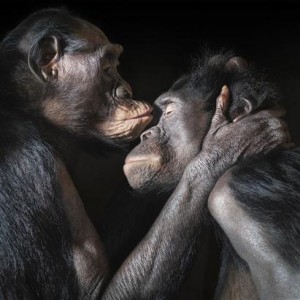
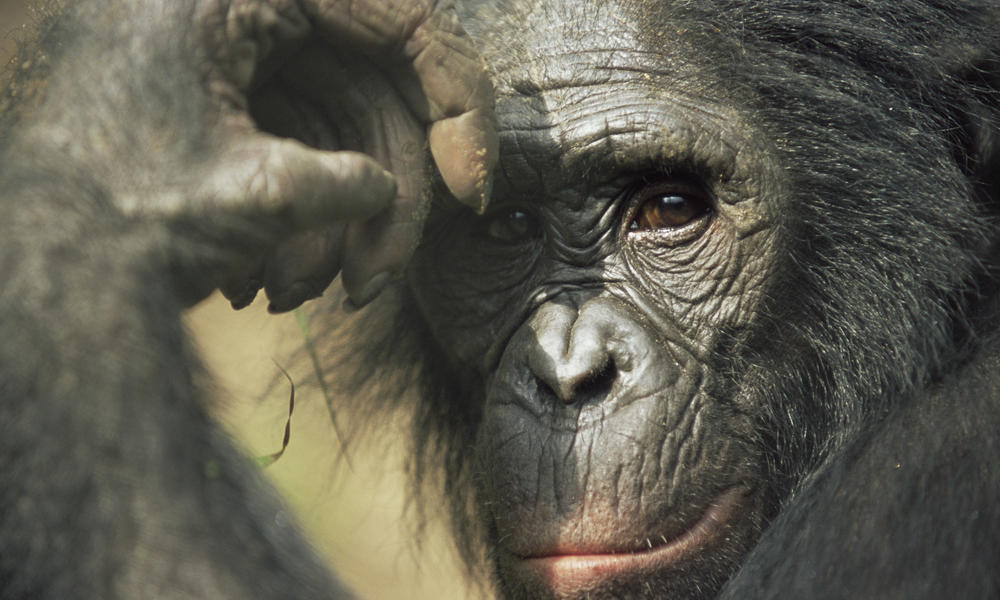
Bonobos, Pan paniscus, are the other chimpanzee…the one we rarely hear about because knowing too much about them might shake up our human (generally speaking) male-dominated, competitive, & ‘stranger-danger’ world view. According to Frans de Waal, bonobos are ‘pan-sexual’ – i.e., anything goes, especially if it can reduce a stressful or conflict-laden situation, or if it’s mealtime, or upon meeting newcomers to the group, or – well, just about anytime with anyone! (except mother-son pairings). They are the only non-human species known to have face-to-face sex & tongue-kiss.  Females are more dominant than males; males gain social status via the status of their mothers.  Bonobos walk on two legs and wade into water more often than chimps; they also have more harmonious and empathetic interactions within their group & with others.  You’ll hear alot more about these primate cousins of ours if you stay tuned to this blog.

But back to the zoo & the human cousins.  By the time we got to the bonobo compound, they were already inside (it was late afternoon & raining – thankfully we’d visited the elephants already).  Boo.  I hope they’ll still be there on my next visit because bonobos (and chimpanzees) are seriously endangered species.  Sadly, these primates with whom we share 98% of our DNA are declining at an alarming rate due to loss of their African habitats & other human-caused factors.  And while alot of research has been done about chimpanzees (Pan troglodytes), we’re still just learning about bonobos: their home territory in the Democratic Republic of the Congo, & their, um, ‘loving’ nature, has kept most researchers at arms length.  There even seems to be disagreement about how to pronounce bonobo!  It’s shocking, really.

Ready to be out of the rain, Roy & I headed over to cousin Mark & husband Paul’s home for dinner with my elderly Uncle Sandy, who is being lovingly cared for by my cousins & Paul.  I happily happened to be with them a few years ago when Mark & Paul got their matching wedding anniversary rings.  These guys are truly married!…irrespective of if or when or how it’s legal.  My brother John & his late partner Alan were ‘married’ in the same way – monogamously bonded for many years.

No doubt you’re getting the connection by now.  There is alot of diversity in our primate family around sexuality.  The amazing thing is that we human primates have evolved the capacity to be aware of & accept this natural variety in our coupling behavior.  Thank you, President Obama, for affirming our primate nature!

Posted in Our Primate Nature | Tagged , , , , , , , , | 5 Comments

More Waterworks: Scottish Showers & Desal

After that last post I thought I’d try for something more pedestrian.  (Please bear with me, I really love that word & will no doubt use it alot.)  So, here’s a question: how often are you in the shower, blithely standing under our pretty-much-always-running-water-on-demand, & all of a sudden you’re flooded with appreciation for hot water?!  for running-water-on-demand, period?!  Then, shower done, the everyday self full of that luxuriant water-flowing-over-the-body appreciation, now, you have the added bonus of turning down the hot water, upping the cold, & finishing off with a cool rinse …aahhh…. we are lucky.  & a cooler head after a shower means a cooler head throughout the day, imho.

Anyhow, that’s how I learned to do it when I lived in Munich at age 20.  It’s officially called a ‘Scottish shower‘ and there are endless permutations – mine’s the simplest version.  I spent alot of time today trying to find a good scientific link supporting the healthfulness of this hot-then-cold habit, but I guess no one’s found it’s worthwhile spending scarce NIH dollars on shower research – too bad.  I still can’t get husband R to try it – of course his head’s pretty cool already.

So – water.  Fresh clean water on demand. Water on our changing planet.  We know that convenient access by humans, plants & other creatures to the water we need and want will become an increasingly challenging & stressful proposition into the future.  97% of the water on earth is saltwater in the oceans.  Of the 3% that is ‘fresh’ water, 2/3 is locked up in glaciers & ice caps (probably not for long though).  Most of the rest is groundwater. Surface water sources, which most of us rely on for fresh water, constitute only 0.007% of the total amount of water on the planet.

Right now, I’m watering my garden because it’s after 5 pm & the day’s water restrictions dictate that I can do that now that the sun’s going down.  Here in our seaside region of Santa Cruz, California, two of the local water districts are collaborating on plans for a water desalination plant to ensure that we have water available into the future.  This proposition is controversial and there are currently competing efforts to put the matter on the ballot. Interestingly, even though the anti-desalination group – which includes many long-time friends – is called Right To Vote on Desal, significantly less than half of the people who are actually customers of these water districts would be able to vote on the project.

Desalination is becoming a more viable option as coastal regions throughout the world face a future of more people, more need to grow more food, and increasing competition for that 0.007% of earth’s water supply.  The big downside seems to be the high energy requirements & associated energy costs.  This is a key issue: easily available, non-renewable energy resources are also going to be in significantly shorter supply into the future.  In our area, the relationship between water availability and growth at the local University of California campus is also a concern.

Because I live outside of the city limits, I already pay more for water than City residents who will be able to vote on this.  Like most of us, I make some, but probably not enough, effort to conserve this precious resource.  The real questions are: am I willing to pay more for the privilege of continued access to fresh-water-on-demand? &, if and when water becomes more scarce, am I willing to give up my garden and my Scottish shower?

Posted in A Warming Planet, Just an Everyday Life | Tagged , , , , , , , , , , , | 4 Comments